Your Diary Is a Budget: Reclaiming Decision Time from Recurring Meetings
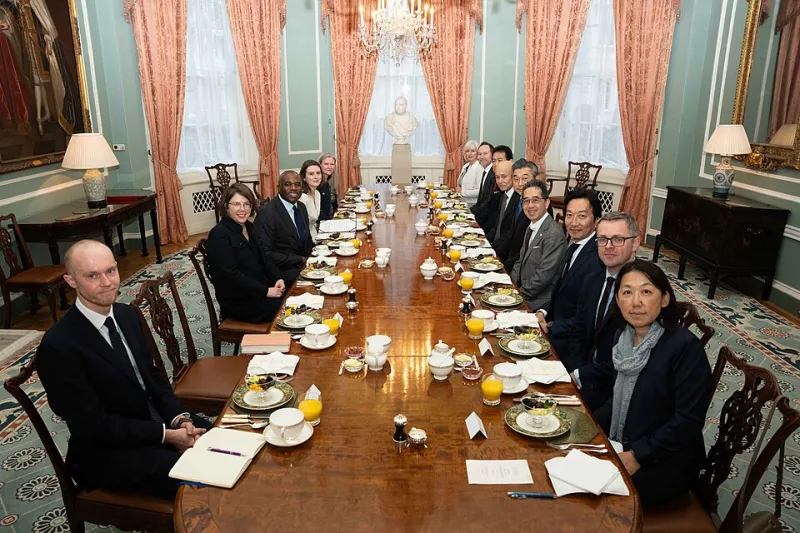
Photo: Foreign, Commonwealth & Development Office, CC BY 2.0, via Wikimedia Commons
Recurring meetings are one of the few business costs that can grow without a purchase order. They appear in the calendar rather than the ledger, so they escape the scrutiny applied to headcount, suppliers or software. For UK SME leaders in 2026, that blind spot is expensive. Margin pressure, slower decision cycles and the constant search for capacity all point to the same question: what is the calendar actually buying?
This is not an argument for cancelling meetings. It is an argument for treating recurring meetings as a budget. A budget has an owner, a limit and a review date. Most recurring meetings have none of these. They persist because they were once useful, because they signal coordination, or because no one wants to be the person who removes them. The result is a hidden tax on management time.
Why the calendar escapes the cost review
A weekly leadership meeting with six attendees feels modest. It is one hour. But it is not one hour. It is six hours of attendee time, plus preparation, plus follow-up, plus the context switching that surrounds it. Multiply that by 48 working weeks and the cost becomes material. Yet because the cost is embedded in salaries rather than invoiced separately, it rarely appears in the same conversation as rent, freight or professional fees.
There is also a cultural reason. In many SMEs, meetings are used as a proxy for coordination. If teams are not talking, the instinct is to schedule a forum. If a project is drifting, the instinct is to add a standing update. Over time, the calendar becomes a museum of past concerns. The original purpose is forgotten, but the slot remains.
A plain-English meeting cost model
The calculation does not need to be perfect. It needs to be consistent enough to force a conversation. Start with a fully loaded hourly cost for each attendee. This should include salary, employer National Insurance, pension contributions and a reasonable share of overhead. Many SMEs already have this figure for costing work or pricing services. If not, finance can provide a sensible estimate.
Use this formula:
Meeting cost = attendee time + preparation + follow-up
For each component, multiply hours by the fully loaded hourly cost. Then annualise the result by the number of times the meeting actually occurs. A simple example: six attendees, 45 minutes a week, an average fully loaded cost of £55 per hour, ten minutes of preparation each and 15 minutes of follow-up each.
- Meeting time: 6 × 0.75 hours × £55 = £247.50
- Preparation: 6 × 0.17 hours × £55 = £55.00
- Follow-up: 6 × 0.25 hours × £55 = £82.50
- Weekly total: £385.00
- Annual total at 48 weeks: £18,480
That is the cash-equivalent cost of one recurring meeting. It does not include the opportunity cost of the work not done, the decisions not made or the customer issue not resolved. Those are harder to quantify, but they are often larger. The point of the model is not to produce a precise number. It is to make the invisible visible.
The one-page recurring-meeting audit
The audit can be completed in a single page. Export four weeks of calendar data for the leadership team and any functions under review. List every meeting that repeats. For each one, capture the following fields:
| Field | What to record |
|---|---|
| Meeting name | The title used in the calendar |
| Owner | The person accountable for its purpose |
| Purpose | The decision, output or coordination it supports |
| Cadence | Weekly, fortnightly, monthly |
| Required attendees | Roles, not names, where possible |
| Duration | Scheduled length |
| Preparation and follow-up | Estimated minutes per attendee |
| Annual cost | Calculated using the model above |
| Decision or output | What changes as a result of the meeting |
| Verdict | Keep, shorten, make asynchronous or scrap |
Once the page is complete, sort by annual cost. The most expensive meetings are not necessarily the worst, but they deserve the first review. Ask three questions of each meeting. What decision does it make? What output does it produce? What would happen if it moved to a written update or a shorter forum? If the answer to the first two questions is unclear, the meeting is a candidate for change.
Classify each meeting into one of four types: decide, inform, coordinate or build trust. Decision meetings usually justify their cost. Information meetings often do not. Coordination can frequently be handled through a shared action log or a concise written brief. Trust-building meetings, such as one-to-ones, may be valuable but should still have a clear purpose and a review date.
Rules for protecting decision time
The audit produces a list. The rules produce a habit. First, every recurring meeting should have a named owner and an expiry date. A 90-day trial is often enough. Open-ended meetings become institutional furniture.
Second, no meeting should exist without a decision, a plan or a record. If the purpose is only to share information, use a pre-read and invite questions in writing. This preserves the meeting for discussion that genuinely benefits from real-time exchange.
Third, set default lengths of 25 and 50 minutes rather than 30 and 60. The shorter default creates a natural prompt to finish and reduces the tendency to fill the available time. Fourth, invite by role rather than habit. Distinguish between required attendees and those who receive the notes. Every optional attendee is a cost that should be justified.
Fifth, use a standing agenda built around decisions, risks and actions. Circulate papers in advance and avoid reading them in the room. Sixth, protect blocks of decision time in the diary. A meeting-free morning once a week is not a perk; it is a capacity decision. Finally, review the meeting budget quarterly. The calendar drifts, and the audit should drift with it.
Coordination without another meeting
Cutting meetings only works if coordination still happens. For many SMEs, the answer is a short written weekly brief covering three things: the metrics that matter, the decisions needed and the risks emerging. A shared action log can replace a status update. A decision log can reduce repeated debates. Clear decision rights can prevent the same issue being escalated to three different forums.
This does not mean every conversation should become a document. Complex, sensitive or ambiguous matters often need face-to-face time. The test is whether the meeting is solving a problem that written communication cannot. If it is, keep it and cost it properly. If it is not, change the format.
Making the change stick in 2026
Start with the five most expensive recurring meetings on the audit page. Run a 90-day experiment. Shorten one, make another asynchronous, merge two and scrap one. Measure the hours reclaimed, the speed of decisions and the quality of outputs. Ask attendees whether the change helped or hindered their work. Avoid across-the-board cuts. A meeting that resolves a significant customer issue or unlocks a major decision may be cheap at £385 a week. The aim is not fewer meetings for their own sake. The aim is a calendar that reflects the priorities of the business.
For UK SME leaders, time discipline is now part of margin discipline. The diary is a budget. It should be reviewed with the same rigour as any other.